

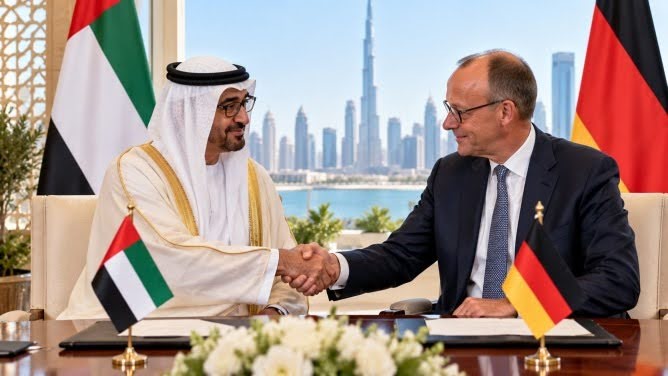
The recent state visit of UAE President Sheikh Mohamed bin Zayed Al Nahyan to Germany underscores a strengthening alliance that has been nurtured over decades. The relationship between the UAE and Germany, which commenced in 1972, has blossomed into a robust partnership characterized by significant political, economic, energy, and cultural collaborations. In recent years, trade and investment have become pivotal components of this bilateral relationship, with trade volumes surpassing Dh57 billion ($15.52 billion) last year. This positions the UAE as Germany’s foremost trading partner in the Gulf region.
Economic collaboration between the two nations is evident, with around 2,000 German companies operating within the UAE. Renowned corporations such as BMW, Siemens, ThyssenKrupp, and Deutsche Bahn have established a presence in the region. Beyond trade, energy cooperation has also intensified, focusing on renewable energy initiatives, climate action, decarbonisation, and ensuring energy security. A landmark agreement in 2022 further solidified this partnership, emphasizing energy security and industrial cooperation, including UAE’s supply of liquefied natural gas to Germany and joint endeavors in clean energy and climate projects.
The UAE-Germany relationship extends into various sectors beyond energy and trade, including research, technology innovation, infrastructure, and cultural exchanges. This multifaceted partnership was officially elevated to a strategic level in 2004, with an agreement that encompasses regional security, economic cooperation, and research collaboration. This strategic partnership has allowed both nations to navigate and strengthen their ties amid global political and economic challenges.
Despite the hurdles posed by global dynamics, the UAE and Germany have maintained a resilient and expanding relationship. Their cooperation across strategic sectors continues to flourish, demonstrating a shared commitment to addressing global issues through collaborative efforts. This steadfast partnership positions both countries to continue working closely on mutual interests, reinforcing their roles as key players in their respective regions and beyond.